On this page
What causes most furnace breakdowns?
Most furnace failures come down to a short list: a failed ignitor or pilot assembly, a dirty flame sensor, a clogged filter choking airflow, a worn blower motor or capacitor, or a thermostat that is misreading the house. A provider tests each part in order rather than guessing.
Edmonds furnaces carry a long, damp heating season, and in the older craftsman and mid-century homes common here the equipment may be decades old. Age, long vent runs in hillside homes and, in some houses, oil heat all change what a provider checks first, so mention your fuel type and roughly how old the furnace is.
What furnace problems are common in Edmonds homes?
Edmonds has older craftsman homes near downtown and mid-century and later houses on the hillsides, and many were built long before central air was common. Furnaces in older homes may be decades-old gas units, and some houses still heat with oil or electric baseboards.
Hillside houses can have long or awkward flue and vent runs, so the vent, draft and combustion air are worth a look when a furnace keeps shutting itself off. If your home has an oil tank or an oil furnace, say so when you call, because repair and replacement steps differ from a gas system.
What warning signs should Edmonds homeowners watch for in a furnace?
Furnaces give notice before they quit, and in a long damp Edmonds heating season the early signs are easy to miss. Watch for:
- Rooms that stay cold — the furnace runs, but a worn blower or ignition trouble leaves output weak, which is common in older systems.
- Delayed or repeated ignition — you hear the furnace click or try to start more than once before the burners catch.
- Banging, popping or squealing — noise at start-up or from the blower often means a part is wearing out.
- A furnace that shuts itself off — after running briefly. In hillside homes with long vent runs a restricted vent or blocked flue can be the trigger; a clogged filter is the other usual suspect.
- Oil smell or soot near an oil furnace — and, for any furnace, a persistent burning or electrical smell.
- A yellow, flickering burner flame — in a gas furnace, instead of a steady blue one.
If your home heats with oil rather than gas, or the furnace is older than you can remember, say so when you call; it changes what the provider checks. A gas smell is its own emergency, covered in the safety section below.
What can Edmonds homeowners safely check before calling?
A cold house is stressful, and a few simple checks sometimes bring the heat back. All of these are safe for a homeowner:
- Thermostat — on Heat, with a setpoint above the room temperature and a lit display. Swap the batteries if the screen is dim.
- Furnace switch and breaker — the switch near the furnace looks like a light switch; make sure it is on, and look for a tripped furnace breaker in the panel.
- Filter — a packed filter can overheat the furnace and trip a limit switch. Replace it if you cannot see light through it.
- Registers — open closed supply registers and clear anything blocking returns, especially in older rooms where furniture crowds the vents.
- Gas valve — on a gas furnace, the shutoff handle near the unit should line up with the pipe. Do not force it.
- Oil tank gauge — if you heat with oil, check the gauge before calling. An empty tank is a common reason an oil furnace stops. Do not open the furnace or adjust fuel lines.
Stop there. Do not open the cabinet, touch gas or fuel components, or bypass a safety switch. If the heat does not return, the next step is a provider.
What happens during a furnace repair visit?
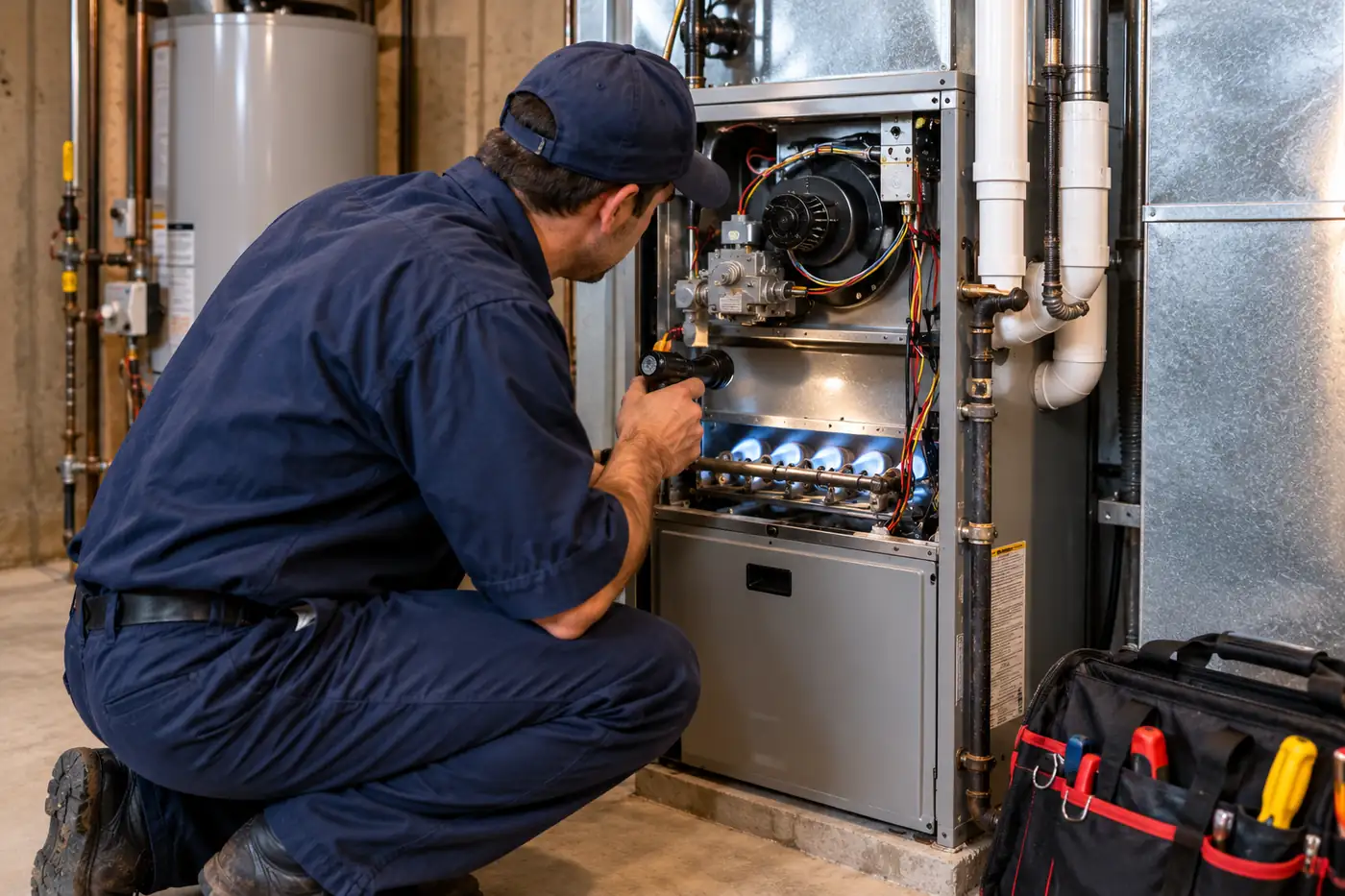
A repair visit follows a sequence. The provider confirms the symptom, then works from the most likely cause outward: thermostat signal, power and safeties, ignition sequence, gas flow and burners, blower and airflow, and finally the heat exchanger. Before any work starts, ask the provider to explain what failed, what the repair involves and what it will cost in writing. The estimate is yours to accept or decline, and if a part has to be ordered, ask for a realistic timeframe. If you live on a hillside or in an older Edmonds home, tell the provider about access to the furnace, crawlspace or outdoor unit so they can plan for it.
What should Edmonds homeowners know about furnace safety?
Whatever the fuel, a furnace is safe when it is maintained and vented properly. If yours burns gas or oil, carbon monoxide is the hazard to respect: it has no color or smell, so put a working CO detector on every floor and test the batteries twice a year.
A gas smell means leave the house, avoid switches and flames, and call your gas utility or 911 from outside. Call a provider promptly for soot around the furnace, a yellow flame, moisture on windows near the unit, or a CO alarm. Never relight a pilot or trace a smell yourself, and in an older hillside installation mention any rust or staining around the vent pipe.
When is repair no longer the right call?
Repair makes sense when the furnace is otherwise sound and the failed part is a normal wear item. In an older Edmonds home the question is often bigger than one part: a decades-old gas or oil furnace that needs repeated repairs may be worth replacing, and a heat pump can take over much of the heating while adding cooling. Ask the provider what the repair costs, what else is likely to need attention soon, and what a replacement would involve in your house, including any vent, flue or oil-tank changes.
Who can help with furnace repair in Edmonds and nearby?
Calls from Edmonds are welcome. Lynnwood Air Comfort is a free referral service and we are not a contractor: your call is connected to an independent local HVAC provider, and coverage depends on that provider, so ask about availability for your address. If you are not sure which problem you have, the heat pump repair in Edmonds and heating not working in Edmonds pages cover the related symptoms.
| Area | What is common there |
|---|---|
| Edmonds | Older homes that may still have oil or early gas furnaces, plus hillside houses with tricky flue runs. |
| Lynnwood | Older gas furnaces in mid-century homes, plus newer high-efficiency units in townhomes near City Center. |
| Bothell | Newer two-story homes with high-efficiency furnaces whose condensate drains and pressure switches cause many calls. |
| Everett | Older furnaces in homes near downtown and the waterfront, plus newer high-efficiency units in subdivisions toward the city’s edges. |
| Mountlake Terrace | Smaller post-war homes where compact ductwork can make a furnace overheat and short cycle. |
Furnace repair questions
Why is my furnace running but blowing cold air?
The burners may not be igniting — a failed ignitor, dirty flame sensor or gas-flow issue are the usual suspects. Check the thermostat and filter first, then call. Running the blower without heat will not warm the house and just runs up the electric bill.
What does it mean when the furnace keeps turning on and off?
That is short cycling. Common causes are a clogged filter overheating the unit, a flame sensor shutting the burners down, or a thermostat issue. Start with a fresh filter; if it continues, the system needs a visit.
Is a yellow pilot light dangerous?
It can signal incomplete combustion, which is worth a prompt call — especially if you also notice soot or the CO detector alarming. Do not ignore it, but do not panic either; just get it checked.
Can I call from Edmonds about furnace repair?
Yes. Calls from Edmonds are welcome. Lynnwood Air Comfort is a free referral service and we are not a contractor: your call is connected to an independent local HVAC provider, and coverage depends on that provider, so ask about availability for your address.
Does an oil or older gas furnace need different repair steps?
Yes, it can. Oil systems add a fuel supply, nozzle and oil filter to the list of things that fail, and older gas furnaces may use parts that are harder to find. If you heat with oil, check the tank gauge, and tell the provider the fuel type and the furnace’s approximate age when you call.
What should I tell the provider when I call from Edmonds?
Say what heats your home (gas, oil, electric or a heat pump), what the system is doing, roughly how old it is, and what you have already checked. Mention your neighborhood in Edmonds so the provider can confirm they cover it.