On this page
What causes most furnace breakdowns?
Most furnace failures come down to a short list: a failed ignitor or pilot assembly, a dirty flame sensor, a clogged filter choking airflow, a worn blower motor or capacitor, or a thermostat that is misreading the house. A provider tests each part in order rather than guessing.
Everett homes span older houses near downtown and the waterfront and newer subdivisions toward the edges of the city, so furnaces here run from decades-old gas units to recent high-efficiency models. Older units tend to fail at ignition parts and blowers, newer ones at drains and safeties. Telling the provider roughly how old the furnace is speeds up the diagnosis.
What furnace problems are common in Everett homes?
Everett is the Snohomish County seat, with older homes in neighborhoods near downtown and the waterfront, hillside houses with views, and newer subdivisions toward the edges of the city. That range means furnaces from decades-old gas units to recent high-efficiency models.
Older furnaces tend to fail at ignitors, flame sensors, inducer motors and blowers, while newer ones more often trip on condensate or vent-pressure safeties. Snohomish County PUD supplies electricity in Everett, and some homes heat with electric baseboards or a heat pump instead of gas, so say what your home uses when you call.
What warning signs should Everett homeowners watch for in a furnace?
Furnaces in Everett range from decades-old units to recent models, and the warning signs depend on age. Watch for:
- No heat, or very little — the thermostat calls and the house stays cold, or the system runs but never warms up.
- Repeated start-up attempts — clicking or humming before the burners light, which is common as ignition parts wear on older furnaces.
- A blower that squeals, rattles or runs weak — wearing bearings or a failing motor.
- Short cycling — the furnace starts, runs a few minutes, shuts off and repeats.
- Higher heating costs — with no change in how you use the house, which can mean an aging furnace is losing efficiency.
- Soot, a yellow flame or a persistent burning smell — a combustion problem worth a prompt call.
Note roughly how old the furnace is and what it burns; the label on the cabinet usually shows the model and date. Never investigate a gas smell yourself.
What can Everett homeowners safely check before calling?
Before you call, a few checks take only minutes and are safe for any homeowner:
- Thermostat settings — Heat mode, a setpoint well above room temperature, a lit display and fresh batteries.
- Power — the furnace switch on or near the unit, and the breaker in the panel.
- Air filter — replace it if it is clogged; reduced airflow can shut a furnace down on its safety limit.
- Supply and return vents — open and unblocked in every room.
- Gas shutoff — on gas furnaces, a handle in line with the pipe means open. Do not force it.
- Age and fuel — note the furnace’s approximate age and fuel type (there is usually a label on the cabinet) so you can tell the provider.
That covers the homeowner steps. Do not open the cabinet, adjust gas or fuel parts or bypass any switch; if heat does not return, call.
What happens during a furnace repair visit?
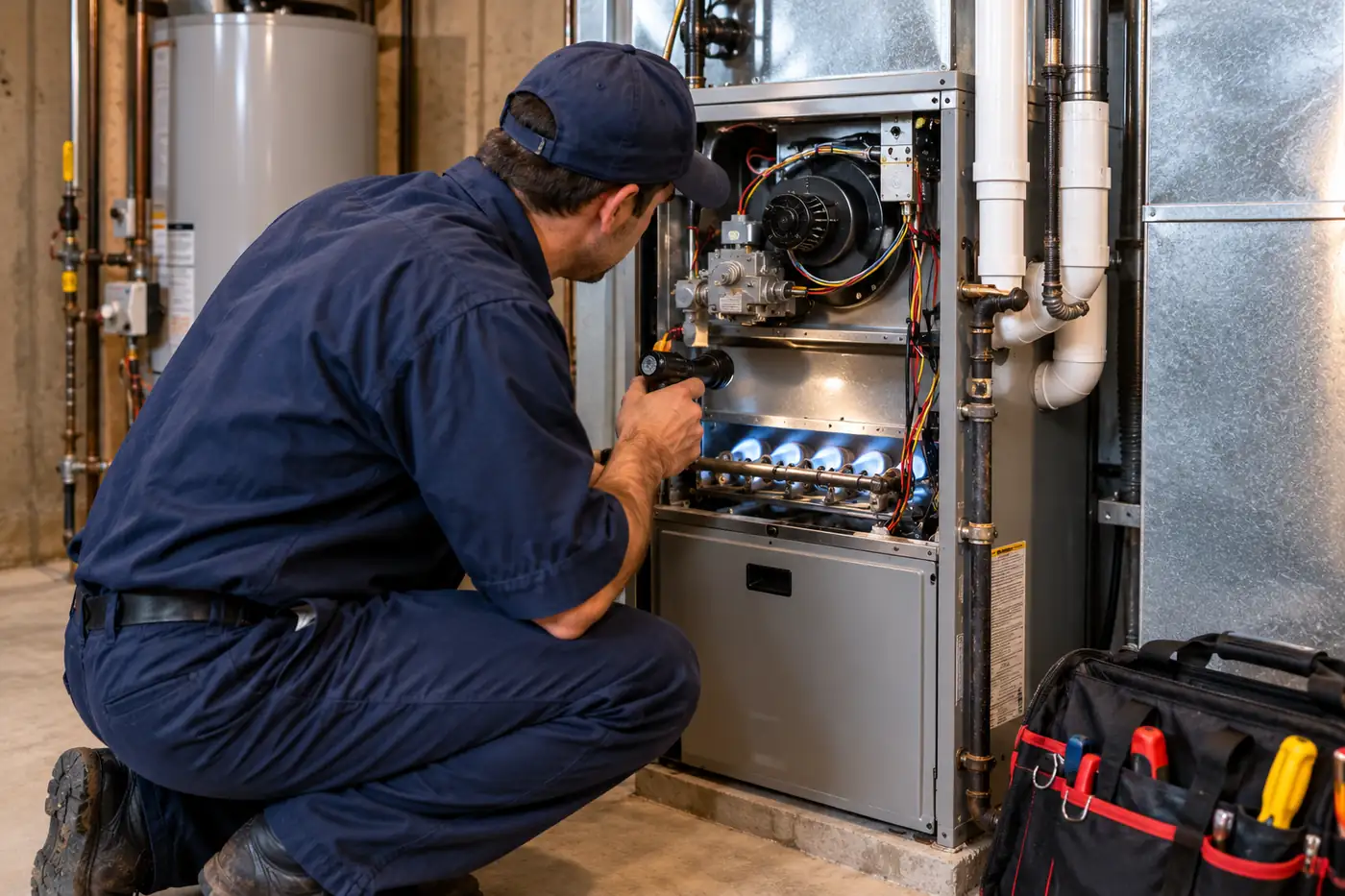
A repair visit follows a sequence. The provider confirms the symptom, then works from the most likely cause outward: thermostat signal, power and safeties, ignition sequence, gas flow and burners, blower and airflow, and finally the heat exchanger. Before any work starts, ask the provider to explain what failed, what the repair involves and what it will cost in writing. The estimate is yours to accept or decline, and if a part has to be ordered, ask for a realistic timeframe. Give the provider your Everett neighborhood and whether the home is older or newer; it helps them know what to expect.
What should Everett homeowners know about furnace safety?
Gas and oil furnaces are safe when maintained, but combustion produces carbon monoxide, which has no color or smell. Keep a working CO detector on every floor and replace the batteries on a schedule. Older furnaces deserve extra attention, because heat exchangers and venting wear with age.
If you smell gas, leave the house at once, avoid switches and flames, and call your gas utility or 911 from outside. Call a provider promptly for a yellow or flickering flame, soot near the furnace or a CO alarm. Do not try to relight a pilot yourself.
When is repair no longer the right call?
Because Everett furnaces range from decades-old units to recent models, the age of yours matters more than the neighborhood. A furnace well into its working life with several repairs behind it is worth pricing against a replacement, while a newer unit with one failed part often is not. Ask the provider for both options in writing, including what each would change about reliability and winter heating costs.
Who can help with furnace repair in Everett and nearby?
Calls from Everett are welcome. Lynnwood Air Comfort is a free referral service and we are not a contractor: your call is connected to an independent local HVAC provider, and coverage depends on that provider, so ask about availability for your address. If you are not sure which problem you have, the heat pump repair in Everett and heating not working in Everett pages cover the related symptoms.
| Area | What is common there |
|---|---|
| Everett | Older furnaces in homes near downtown and the waterfront, plus newer high-efficiency units in subdivisions toward the city’s edges. |
| Lynnwood | Older gas furnaces in mid-century homes, plus newer high-efficiency units in townhomes near City Center. |
| Edmonds | Older homes that may still have oil or early gas furnaces, plus hillside houses with tricky flue runs. |
| Bothell | Newer two-story homes with high-efficiency furnaces whose condensate drains and pressure switches cause many calls. |
| Alderwood Manor | Furnaces and AC coils that aged together and often fail in the same few seasons. |
Furnace repair questions
Why is my furnace running but blowing cold air?
The burners may not be igniting — a failed ignitor, dirty flame sensor or gas-flow issue are the usual suspects. Check the thermostat and filter first, then call. Running the blower without heat will not warm the house and just runs up the electric bill.
Is a yellow pilot light dangerous?
It can signal incomplete combustion, which is worth a prompt call — especially if you also notice soot or the CO detector alarming. Do not ignore it, but do not panic either; just get it checked.
Can I reset my furnace myself?
Many furnaces have a reset button or can be reset by switching the power off for a minute. One reset attempt is reasonable. If it trips again or will not stay running, stop resetting it and call — repeated resets can mask a safety issue.
Can I call from Everett about furnace repair?
Yes. Calls from Everett are welcome. Lynnwood Air Comfort is a free referral service and we are not a contractor: your call is connected to an independent local HVAC provider, and coverage depends on that provider, so ask about availability for your address.
Is it worth having an older furnace checked before cold weather?
Often, yes. A pre-season check can find weak ignition parts, a dirty flame sensor or a clogged filter before a cold night forces the issue, and it gives you time to compare repair and replacement. Ask the provider what they inspect and to explain the findings.
What should I tell the provider when I call from Everett?
Say what heats your home (gas, oil, electric or a heat pump), what the system is doing, roughly how old it is, and what you have already checked. Mention your neighborhood in Everett so the provider can confirm they cover it.
Related services
Nearby: HVAC and AC services in Lynnwood and AC and HVAC services in Bothell.